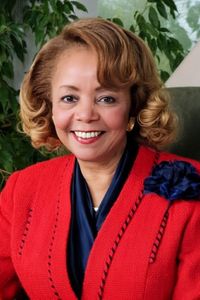
Two weeks ago when I learned that Dr. Marvalene Hughes, my first boss, passed away on January 3rd I instantly started to cry. Although I had only the honor of working with her for approximately three years, she had a tremendous impact on my career in higher education and how I lead.
During my second year of graduate school I applied for two positions as an Administrative Fellow in the Office for Student Affairs. One was in the Vice President’s and the other was in the Sexual Violence Program (which later became the Aurora Center). I took a risk in applying because my intended career path was not aligned with the intentions of the program which was to provide practical experience for those who were future student affairs or higher education professionals. I was offered both positions and I would learn many years later that Dr. Hughes and the late director of the Sexual Violence Program, Jamie Tiedemann fought over me and agreed to each take me for ten hours a week. My position as an Administrative Fellow lasted two years and that position led to me being hired as the Assistant to the Vice President for Student Affairs. My first full-time position.
A core characteristic of the way that I lead is that I center empathy, or try very hard to do so. Dr. Hughes modeled empathy in many ways. One of my core memories of Dr. Hughes is her rushing to tend to a cheerleader who fell on the concrete while performing on the plaza outside the administration building, while many others just stood there. After determining that the student could be moved, she drove her to the student health center in her car.
Dr. Hughes demonstrated what it means to be an ally. While I was still a graduate assistant I shared with Dr. Hughes that several students who were friends were experiencing homophobia in various ways in the residence halls, including from an RA. She convened a meeting with me, my two friends, and the director and assistant director of Housing and Residential Life to discuss their concerns. When there were efforts to create a student cultural center for GLBT students she supported their efforts at a time when such support was not guaranteed. Dr. Hughes served as a moderator for a campus panel that was part of a national teleconference on GLBT issues. I was asked to serve as a student member of the panel. During a time when members of the GLBT community didn’t always feel welcome and safe at the University of Minnesota, or in society at large, Dr. Hughes was a visible and vocal ally.
Dr. Hughes modeled the importance of leaders with marginalized identities helping to welcome others with shared identities to the University and the community. For example, she hosted a gathering at her home for a newly hired African American faculty member who joined the University as the inaugural holder of an endowed chair dedicated to addressing racial and ethnic inequality.
Dr. Hughes modeled how to deal with unwarranted criticism or situations when you are portrayed by others in ways that are unfair. The Minnesota Daily, our school newspaper, once printed a picture of her that made this beautiful woman look anything but alongside a story that was critical of her. I asked her how she dealt with such situations and she said without hesitation “I let it roll off of my back like water.”
Dr. Hughes helped me understand what it means to take pride in the work that you put out into the world. She was a perfectionist and although there was a time where this characteristic caused me to have a mini-emotional breakdown at work, I grew to understand why perfection was important for her. As an African American woman leader in a predominantly white university, she did not have the luxury of making mistakes and having them waived off as “well no one is perfect”. She understood that mistakes would cause some to question her abilities or discount her credibility. Her attention to detail helped me to understand the importance of getting the names and titles of people, programs, and organizations right. I particularly learned the importance of the various types of professors that exist at a university such as ours.
Dr. Hughes helped me understand the importance of how you show up at work. She was always dressed to the nines and she had a presence when she entered a room. She knew that how you presented yourself impacted how others would view you and your abilities, particularly because of her identity. For much of my professional life I wore suits nearly every day. Although I dress much more casually for work now I am often conflicted about my attire. As someone who considered Dr. Hughes a mentor wrote recently:
“Dr. Hughes was always impeccably dressed. I often picture her in St. John Knits, tailored, elegant, and regal. It was never about fashion for fashion’s sake. It was about dignity and command. She understood how you show up matters, especially when you carry the weight of history, responsibility, and representation. She taught by example that leadership is not simply what you say or do, but how you inhabit space. How you carry yourself. How you honor the rooms you enter and the people watching, particularly those who need to see excellence reflected in them.”
Dr. Hughes modeled the importance of making time for people and showing up. As a vice president she was extremely busy, but she carved out time on her schedule to meet with students, not just student leaders. The “student time” on her calendar was sacrosanct. She graciously agreed to attend many of the events she was invited to because she knew her presence mattered to others.
There are many aspects of how I lead and how I do my job (whatever that job may be) that reflect the lessons I learned from Dr. Hughes. The way I lean into empathy. The way that I make time to meet with anyone who wants to meet with me. The way that I show up at various events, not just ones where I have a role to play. The way that I try to be an ally for others. The way that I try to help those who are not having the experience they would like to have at the University or the college where I work. The level of professionalism (and I know that it is a contested concept) that I bring to my work.The way that I make sure that people who need to be heard and seen are. The way that I am generous with my time when new people join the University community and either ask to meet with me, or are referred to by others to meet with me. The ways in which I show up as an African American and as a gay man.
Dr. Hughes helped me see that hard work and determination can pay off. She left the University of Minnesota to become a president at California State University, Stanislaus, and later became president at Dillard University. In both instances she was the first woman president at the institution, and in the case of the former, the first African American one. At the time she became a college president for the first time, in 1994, it was extremely rare for a Vice President for Student Affairs to become a college or university president. It is much more common now, but back then you could count the ones who had followed that path on your two hands with some fingers unused.
The last time I saw Dr. Hughes was in 2006. We were both attending the annual American College Personnel Association conference in Indianapolis and she was receiving an award, which recognized her efforts to rebuild Dillard University after Hurricane Katrina. Years prior she served as president of the Association. I stopped by the room where the awards luncheon was taking place just to say hello and to let her know what I was doing in my career. She saw me and a former Student Affairs colleague from the University of Minnesota who was also at the conference. After the shock of seeing us, we were immediately welcomed into the room, hugged, and invited to sit at her table, the head table, for the event. That’s the kind of person she was.
I never had the chance to fully thank Dr. Hughes for all she had done for me and my career, although she is included in the acknowledgments for both my master’s thesis and dissertation (the topic for the latter was inspired by my working for her and several other vice presidents that would follow). I wrote to her once after I finished my PhD, but I had the wrong address and I was not able to track down the right one. While she may not have known how grateful I was in the way I would have liked her to, the way that I move through my life as a higher education professional and as a leader is a tribute to all that I learned from her. I was not able to give her the flowers she deserved while she was alive, so the least I can do is honor her by the way that I show up as a higher education professional.
While I am not a member of the Jewish faith, at the risk of being guilty of cultural appropriation, I will use a phrase that is used to honor the deceased: May her memory be a blessing. It certainly is for me.
 Some Things on My Mind and My Heart
Leave a comment